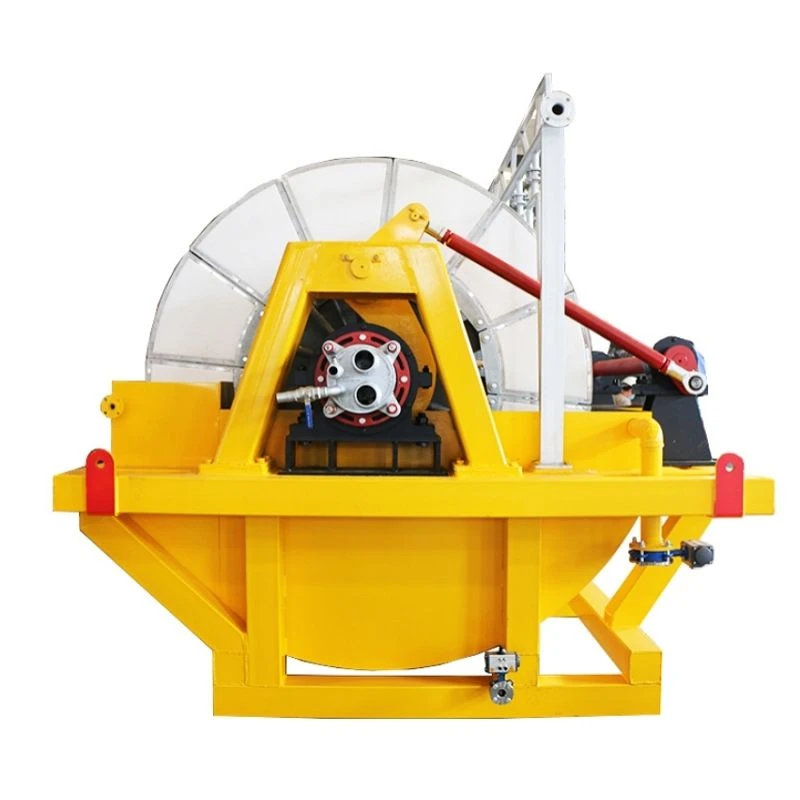
Choosing a ceramic vacuum filter is not simply a matter of comparing filtration capacity, vacuum pressure, or equipment price. The right filtration system must be matched to the material characteristics, required cake moisture, slurry concentration, particle size distribution, filtration cycle, downstream process, and long-term operating conditions.
For mineral processing plants and industrial operations, a poorly matched filter can result in low throughput, excessive moisture in the filter cake, unstable vacuum performance, high energy consumption, frequent ceramic plate cleaning, and unnecessary maintenance costs.
This guide explains the most important factors to consider when selecting a ceramic vacuum filter, including filtration technology, ceramic plate specifications, processing capacity, slurry characteristics, vacuum requirements, cake moisture, energy consumption, maintenance, and total cost of operation.
It also explains how Zhongyu approaches ceramic vacuum filtration from an engineering perspective and what information buyers should prepare before requesting a quotation.
What Is a Ceramic Vacuum Filter?
A ceramic vacuum filter is a continuous solid-liquid separation machine that uses microporous ceramic filter plates as the filtration medium.
Unlike conventional cloth-based vacuum filters, the ceramic plate contains a network of fine pores. The ceramic surface is hydrophilic, allowing liquid to pass through while preventing air from easily penetrating the filtration medium.
During operation, vacuum pressure creates a pressure difference between the slurry side and the internal channels of the ceramic filter plate. Liquid is drawn through the micro pores into the plate's internal system, while solid particles accumulate on the outer surface and form a filter cake.
The basic filtration process can be summarized as:
Slurry feeding → Cake formation → Vacuum dewatering → Filtrate discharge → Cake removal → Ceramic plate regeneration

This operating principle makes ceramic vacuum filtration particularly attractive for mineral filtration and other applications where low cake moisture, clear filtrate, continuous operation, and reduced energy consumption are important.
However, not each project is suitable for the same ceramic filter configuration.
That is why equipment selection should begin with the material, not the machine size.
Why Are Vacuum Ceramic Filters Becoming More Popular?
Traditional vacuum filtration technologies can perform well in many applications, but they often rely on consumable filter cloths and require significant airflow from the vacuum system.
Ceramic filtration approaches the problem differently.
The rigid ceramic medium combines mechanical strength, microporous filtration, hydrophilic properties, and long service life. Under suitable operating conditions, the ceramic plate can achieve efficient liquid removal while minimizing the amount of air entering the vacuum system.
This can create several potential advantages:
- Lower filter cake moisture
- High filtrate clarity
- Reduced filter cloth consumption
- Lower vacuum airflow requirements
- Potentially lower operating energy consumption
- Long ceramic plate service life
- Continuous automated operation
- Reduced downstream drying requirements
- Better suitability for abrasive mineral slurries
For mineral processing plants, however, the most important question is not whether ceramic filtration is better.
The real question is:
Will a ceramic vacuum filter deliver economics for your specific slurry?
10 Key Factors to Consider When Choosing a Ceramic Vacuum Filter
1. Start With Your Material Characteristics
The most common mistake when purchasing filtration equipment is selecting the machine based only on the desired tonnage.
Filtration performance is strongly influenced by the material being processed.
Before selecting a ceramic vacuum filter, evaluate at least the following characteristics:
Particle Size
Particle size distribution directly affects cake formation, filtration resistance, and filtrate flow.
For example, a relatively coarse mineral concentrate may form a permeable cake quickly, while ultrafine particles can create a dense cake with higher filtration resistance.
Important information includes:
- D50 particle size
- Percentage passing 200 mesh
- Percentage of ultrafine particles
- Particle size distribution
- Particle morphology
Do not evaluate particle size only from a single average value.
Two slurries with the same D50 can behave very differently during vacuum filtration because their overall particle distributions are different.
2. Slurry Concentration Matters More Than Many Buyers Expect
Feed concentration has a direct impact on cake formation and filtration capacity.
A very dilute slurry may require more liquid to be removed before the desired cake thickness is achieved. Conversely, an excessively concentrated slurry can create feeding and distribution problems.
When requesting a quotation, provide:
- Feed solids concentration
- Slurry density
- Slurry temperature
- Feed flow rate
- Solid throughput
- Liquid composition
For mineral concentrate applications, a solids concentration around 30–45% may be suitable for many ceramic filtration systems, but the optimum operating range depends on the specific material and process design.
Do not use a generic concentration range as a substitute for testing.
3. Determine the Required Filter Cake Moisture
Cake moisture is one of the most important parameters when selecting filtration equipment.
A filter may achieve high throughput but still be economically unattractive if the resulting cake contains too much water.
This is especially important when the filter cake is subsequently:
- Dried
- Smelted
- Transported
- Stockpiled
- Sold as concentrate
- Used as a raw material
A lower cake moisture content can reduce the amount of water entering downstream processes.
4. Understand Ceramic Filter Plate Pore Size
The ceramic filter plate is the heart of a ceramic vacuum filter.
Microporous ceramic media can be manufactured with different pore structures and filtration characteristics. A typical ceramic filtration system may use micropores in the micrometer range, but the appropriate pore structure depends on the slurry.
Pore size should not be selected solely according to the smallest particle in the feed.
If the pores are excessively fine, filtration resistance may increase.
If the filtration structure is poorly matched to the material, fine particles may penetrate or rapidly block the filtration surface.
The correct selection therefore considers:
Particle size distribution + cake permeability + filtrate clarity + regeneration requirements + slurry chemistry
This is one reason laboratory or pilot testing is valuable before purchasing a large industrial system.
5. Check Vacuum Requirements - Don't Look Only at Vacuum Level
Many buyers focus on the maximum vacuum level listed in a technical specification.
For example, they may compare machines based on whether the system can achieve approximately -0.09 MPa.
But maximum vacuum alone does not determine filtration performance.
The more important questions are:
How stable is the vacuum during operation?
How much air does the system need to remove?
What is the actual vacuum airflow?
How much vacuum pump power is required?
How does the system perform as the ceramic plate becomes fouled?
How effectively is the ceramic medium regenerated?
A ceramic vacuum filter can take advantage of the ceramic medium's low air permeability to reduce unnecessary air extraction.
This is potentially important for energy efficiency because the vacuum pump does not need to continuously handle large quantities of air.
The goal is not simply to create a stronger vacuum. The goal is to create the right pressure difference with minimum unnecessary energy consumption.
6. Calculate Capacity Based on Your Actual Material
Ceramic filter capacity is often expressed in:
t/h
kg/m²·h
m³/h
filtration area
However, advertised capacity should never be treated as a universal number.
A machine rated for a certain throughput under one mineral condition may produce a very different result with another slurry.
Actual capacity depends on:
Material properties × slurry concentration × particle size × cake thickness × vacuum conditions × cycle time × ceramic permeability
For this reason, a better purchasing approach is to provide the supplier with a target such as:
Required dry solids capacity: 50 t/h
Feed concentration: 35%
Target cake moisture: ≤10%
Particle size: approximately 75% passing 200 mesh
The manufacturer can then recommend the appropriate filtration area and configuration.
7. Consider Filtrate Quality
Filtrate clarity is another major advantage that can make ceramic filtration attractive.
Because the ceramic medium contains controlled micropores, the filtrate can have a very low suspended-solids concentration under suitable operating conditions.
This matters when the filtrate is:
Recycled to the process
Returned to a thickener
Reused as process water
Sent to downstream treatment
Subject to environmental discharge requirements
A clearer filtrate can reduce the load on subsequent treatment equipment and decrease fresh-water consumption.
Therefore, when evaluating suppliers, ask for actual filtrate quality data from materials similar to yours rather than relying only on general statements such as "high filtration efficiency."
8. Evaluate the Ceramic Plate Regeneration System
A ceramic filter does not simply operate continuously without cleaning.
Over time, fine particles, scale, chemical deposits, or other contaminants can reduce the permeability of the ceramic surface.
An effective regeneration system is therefore essential.
Common regeneration approaches include:
- Backwashing
- Acid cleaning
- Ultrasonic cleaning
- Chemical regeneration
- Combined cleaning processes
The correct cleaning strategy depends on the nature of the deposit.
For example:
Mineral particles → backwashing and physical cleaning
Inorganic scaling → chemical cleaning may be required
Fine particle blockage → deeper regeneration may be necessary
A good ceramic vacuum filter should therefore be evaluated as a complete filtration-and-regeneration system, not simply as a machine containing ceramic plates.
9. Examine Ceramic Plate Service Life
One of the economic advantages of ceramic filtration is that ceramic plates are not equivalent to conventional disposable filter cloths.
Filter cloths are consumable components and normally require periodic replacement.
Ceramic plates are rigid filtration elements designed for long-term operation and can often be regenerated repeatedly.
Under appropriate operating conditions and maintenance practices, ceramic plates may provide several years of service.
However, actual service life depends on:
- Slurry abrasiveness
- Mechanical impact
- Chemical environment
- Cleaning frequency
- Cleaning chemicals
- Operating hours
- Plate handling
- Maintenance quality
A supplier should therefore be able to explain not only the expected ceramic plate life but also the factors that affect it.
10. Look at Total Cost of Ownership Instead of Purchase Price
The lowest equipment quotation is not necessarily the lowest-cost filtration solution.
A more useful calculation is:
Total Cost of Ownership =
Equipment investment + electricity + consumables + maintenance + ceramic plate replacement + cleaning chemicals + labor + downtime + downstream drying costs
This is particularly important for large mineral processing plants operating continuously.
A filtration system with a higher initial price may have a lower lifetime cost if it provides:
- Lower energy consumption
- Lower cake moisture
- Longer filtration media life
- Lower consumable consumption
- Reduced maintenance
- Higher availability
- Lower downstream drying demand
For this reason, purchasing decisions should be based on cost per tonne of dry solids, rather than equipment price alone.
Ceramic Vacuum Filter vs. Traditional Cloth Vacuum Filter
A ceramic vacuum filter and a conventional cloth disc filter are not simply two versions of the same technology.
| Factor | Ceramic Vacuum Filter | Conventional Cloth Vacuum Filter |
|---|---|---|
| Filtration medium | Microporous ceramic | Filter cloth |
| Air permeability | Very low | Relatively higher |
| Consumable media | Ceramic plates are long-life components | Cloth requires periodic replacement |
| Cake moisture | Often lower under suitable conditions | Depends strongly on material and operation |
| Filtrate clarity | Typically high | Depends on cloth and slurry |
| Energy demand | Potentially lower | Higher vacuum airflow may be required |
| Abrasion resistance | High | Cloth can be vulnerable to wear |
| Cleaning | Regeneration system | Cloth washing/replacement |
| Continuous operation | Yes | Yes |
| Best applications | Mineral concentrates and suitable fine slurries | Broad range of industrial slurries |
The key takeaway is not that ceramic filtration replaces every conventional filter.
Instead:
Ceramic filtration is particularly valuable when low cake moisture, low consumables, clear filtrate, and long-term operating efficiency are important.
Which Industries Use Ceramic Vacuum Filters?
Ceramic vacuum filtration is widely considered for applications where solid-liquid separation and mechanical dewatering are critical.
Typical applications include:
Mining and Mineral Processing
Iron ore concentrate
Copper concentrate
Gold concentrate
Lead-zinc concentrate
Lithium minerals
Rare-earth minerals
Nickel concentrate
Manganese concentrate
Non-metallic minerals
Chemical Processing
Chemical slurries
Precipitated materials
Industrial crystallization products
Chemical solid-liquid separation
Environmental Applications
Industrial sludge
Wastewater treatment
Sludge dewatering
Process-water recovery
The best application is determined by the material characteristics rather than simply by the industry name.
How to Select the Correct Ceramic Vacuum Filter Size
Suppose a plant needs to process 100 tonnes of dry concentrate per hour.
The first step should not be:
"Which 100 t/h machine should we buy?"
Instead, the engineering calculation should consider:
Required dry solids throughput
Feed solids concentration
Particle size distribution
Cake formation characteristics
Target cake moisture
Filtration cycle
Expected specific capacity
Required filtration area
Number of operating units
Standby capacity
For continuous industrial plants, redundancy is also important.
For example, a plant may choose several smaller filtration units instead of one extremely large machine to improve operational flexibility and maintenance availability.
The final configuration should be determined through process calculations and, where necessary, filtration testing.
What Data Should You Send a Ceramic Filter Manufacturer?
If you want an accurate quotation, sending only the required tonnage is usually insufficient.
A professional supplier will normally need information such as:
Feed Information
Material name
Feed rate
Solid concentration
Slurry density
Particle size distribution
Temperature
pH
Chemical composition
Product Requirements
Required dry solids capacity
Target cake moisture
Required filtrate clarity
Cake discharge requirements
Operating Conditions
Operating hours per day
Continuous or batch operation
Available power supply
Available water
Existing vacuum system
Installation environment
Site Information
Available installation area
Elevation
Ambient temperature
Existing process equipment
Automation requirements
The more complete the information, the more reliable the equipment selection will be.
7 Questions to Ask Before Buying a Ceramic Vacuum Filter
Before signing a purchase contract, ask the manufacturer:
1. Has the equipment been tested with material similar to ours?
Laboratory or pilot testing can significantly reduce selection risk.
2. What filtration capacity can you guarantee?
Ask for capacity under defined material and operating conditions.
3. What cake moisture can you guarantee?
A capacity guarantee without a moisture target may not provide enough protection for the buyer.
4. What is the expected power consumption per tonne?
This is more useful than simply knowing installed motor power.
5. How long do the ceramic plates normally last?
Ask what operating conditions the estimate assumes.
6. What regeneration methods are available?
Cleaning capability can directly influence long-term performance.
7. What happens if filtration performance decreases?
A supplier should have a clear inspection, cleaning, maintenance, and troubleshooting procedure.
Why Equipment Testing Is More Important Than Brochure Specifications
Filtration is highly material-dependent.
A brochure can tell you the machine's dimensions, installed power, filtration area, and nominal capacity.
It cannot fully predict how your slurry will behave.
Two concentrates may have:
Similar particle sizes
Similar concentrations
Similar densities
but produce very different filtration results because of differences in particle shape, mineral composition, surface chemistry, cake permeability, and settling behavior.
This is why a serious filtration equipment supplier should be able to discuss material testing and process validation rather than simply recommending a machine from a capacity table.
Why Choose Zhongyu for Ceramic Vacuum Filtration?
Zhongyu approaches ceramic vacuum filtration from an equipment-engineering perspective rather than treating the ceramic filter as a standalone machine.
The objective is to match the filtration system with the customer's actual process conditions.
Depending on the project, Zhongyu can evaluate:
Material characteristics
Slurry concentration
Particle size distribution
Required filtration capacity
Cake moisture target
Vacuum conditions
Ceramic plate configuration
Cleaning and regeneration requirements
Automation requirements
Downstream process integration
This approach helps customers avoid a common purchasing mistake:
buying a machine first and trying to make the process fit the machine later.
Instead, the filtration system should be designed around the process.
The Real Value of a Ceramic Vacuum Filter
The value of a ceramic vacuum filter should not be measured only by how many tonnes it can process per hour.
A better evaluation considers the entire production chain.
For example:
Better dewatering
↓
Lower filter cake moisture
↓
Less water entering downstream processes
↓
Lower drying load
↓
Potentially lower energy consumption
↓
Lower operating cost per tonne
At the same time:
Long-life ceramic media
↓
Reduced consumable replacement
↓
Less maintenance and downtime
↓
More stable continuous production
This is where ceramic vacuum filtration can create value beyond the filtration step itself.
Ceramic Vacuum Filter Buying Checklist
Before requesting quotations, make sure you can answer these questions:
☐ What material are you filtering?
☐ What is the required dry solids capacity?
☐ What is the feed solids concentration?
☐ What is the particle size distribution?
☐ What is the target filter cake moisture?
☐ What filtrate quality is required?
☐ What is the slurry temperature and pH?
☐ Is the slurry abrasive?
☐ Are there scaling or chemical fouling problems?
☐ How many operating hours are required per day?
☐ Is continuous operation required?
☐ What power supply is available?
☐ What cleaning system is required?
☐ Is pilot testing available?
☐ What performance guarantees does the supplier provide?
☐ What is the expected cost per tonne over the equipment's service life?
If you cannot answer several of these questions, a professional manufacturer should help you determine them before final equipment selection.
Final Thoughts: How to Choose the Right Ceramic Vacuum Filter
The best ceramic vacuum filter is not necessarily the largest machine, the machine with the highest vacuum level, or the lowest-priced quotation.
It is the system that provides the right combination of:
Capacity + cake moisture + filtrate quality + energy consumption + reliability + maintenance requirements + lifetime cost
For mineral processing applications, the selection process should begin with the slurry and end with a complete lifecycle cost analysis.
If your application involves iron ore, copper, gold, lithium, lead-zinc, rare-earth minerals, chemical slurries, or industrial sludge, Zhongyu can evaluate the process conditions and recommend a ceramic filtration configuration based on the actual application rather than a generic equipment specification.
Need Help Selecting a Ceramic Vacuum Filter?
Send Zhongyu your material type, feed capacity, slurry concentration, particle size distribution, target cake moisture, and operating requirements.
Our engineers can use this information to determine the appropriate filtration area, equipment configuration, and operating parameters for your application.
Don't choose a ceramic filter by machine size alone. Choose it by process performance and total cost of ownership.