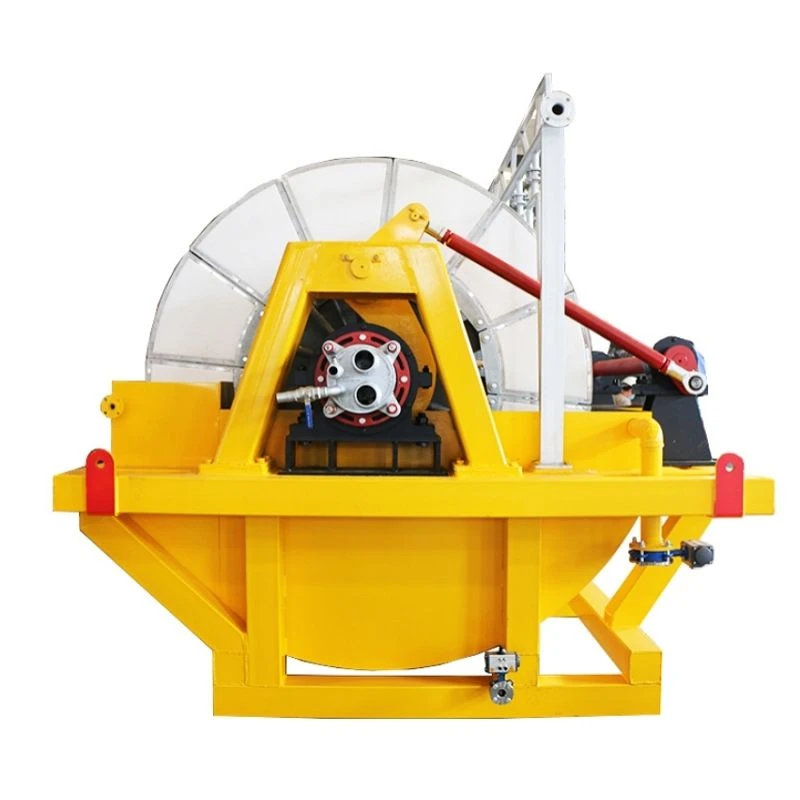
Key Parameters of Disc Vacuum Filters
Disc vacuum filters are available in different sizes and configurations, and their operating parameters should be selected according to the material characteristics and process requirements. The main parameters include filtration area, vacuum level, disc rotation speed, processing capacity, filter cake moisture, motor power, and equipment dimensions.
Filtration Area
The filtration area is one of the main factors affecting the processing capacity of a disc vacuum filter. A larger filtration area generally provides greater capacity under comparable operating conditions. However, actual performance also depends on slurry concentration, particle size, cake permeability, filter cloth selection, and other process conditions.
Vacuum Level
The vacuum level creates the pressure difference required for liquid to pass through the filter cloth while retaining solid particles on its surface. A vacuum level of approximately -0.06 to -0.09 MPa is commonly used in disc vacuum filtration, although the appropriate operating level varies with equipment design and material characteristics.
Disc Rotation Speed
Disc rotation speed affects the time available for cake formation and vacuum dewatering during each filtration cycle. The appropriate speed depends on the filter design, slurry properties, required capacity, and target cake moisture. A suitable rotation speed helps balance filtration capacity with effective cake dewatering.
Processing Capacity
Processing capacity varies significantly with equipment size and material properties. It is influenced by filtration area, solids concentration, particle size, cake permeability, and operating conditions. Therefore, capacity should be evaluated based on the actual slurry rather than relying on a single standard value.
Filter Cake Moisture
Filter cake moisture is an important performance indicator, particularly when the recovered solids will undergo transportation, drying, combustion, or further processing. The achievable moisture content depends strongly on the material and operating conditions. For example, coal slurry may produce filter cakes with moisture levels around 20–30% under certain conditions, but actual results can vary.
Motor Power
Motor power depends on the size and configuration of the disc vacuum filter, as well as the operating requirements of the system. It provides power for the main drive and other equipment components. The final motor specification should therefore be selected according to the complete equipment configuration and process requirements.
Equipment Dimensions
The overall dimensions of a disc vacuum filter vary according to its model, filtration area, and configuration. Length, width, and height should be considered together with the available installation space, slurry tank arrangement, discharge system, piping, and maintenance access.
Selecting the Right Parameters
These parameters are closely related and should not be evaluated separately. A larger filtration area does not automatically guarantee better filtration performance, while a higher vacuum or faster rotation speed is not necessarily better for every material.
For a suitable disc vacuum filter, filtration area, vacuum level, rotation speed, processing capacity, and target cake moisture should be matched to the specific slurry and production requirements. A process-based equipment selection can help achieve stable filtration performance while avoiding unnecessary equipment size and operating costs.